Im Spätsommer 2026 stand ein äußerst interessanter Termin an: Yona Hümmels ist gemeinsam mit Sietse Bakker dabei, Europas erste vollelektrische Airline zu gründen. Im Interview tauschten wir uns intensiv über die Marktchancen, technische Herausforderungen und die nächsten Schritte aus. Hier das Interview auf Englisch für Euch in voller Länge. Für mich steht fest: Elektrische Luftfahrt nimmt Gestalt an…
Viel Vergnügen beim Lesen!
Benjamin Zwack: What was the decisive motivation behind founding Vlindair?
Yona Hümmels: My co-founder Sietse Bakker and I both care deeply about aviation, but even more about our planet. For a long time, those two passions felt increasingly hard to reconcile. A flight in a small aircraft made that tension very tangible for me. I experienced how much time a fast, direct regional connection can save, and at the same time how difficult that is to justify when it runs on fossil fuel.
We began looking more closely at electric aircraft and realised that building them is only half the challenge. Aircraft alone don’t create a network. Someone also has to turn them into a useful transport service. That is the role we are taking on: an operator that connects regions with small electric aircraft, develops routes that work commercially, and creates demand at a scale that gives manufacturers and airports a reason to invest.
Benjamin Zwack: Which specific gap in the European mobility system do you want to close first, and how can you determine whether a route is genuinely needed?
Yona Hümmels: We are looking at pairs of regions that are relatively close in a straight line but poorly connected in practice. Take a region like Twente, in the east of the Netherlands. Many business destinations in neighbouring countries are only a few hundred kilometres away as the crow flies, yet getting there can take most of a day by train, with several changes, or a detour through a major hub airport. Electric aircraft could make some of those journeys direct and substantially shorter.
„Flying in Europe is broken – and the planet is paying for it.“
Europe already has many regional airfields. Our first task is to identify where using them would solve a real travel problem, rather than simply draw attractive lines on a map. We’ve built a network intelligence platform that compares potential routes on travel time, likely passenger demand, aircraft performance and operating costs. We then test those assumptions with airports, regions, businesses and prospective passengers. A route is only compelling if enough people want to use it at a price that works for them.
Better connections to and from airports will strengthen the proposition over time, but the route needs to make sense with the ground transport available when we launch.
Benjamin Zwack: Which milestones need to be achieved before your first commercial flight?
Yona Hümmels: The decisive milestone is a certified aircraft that can carry enough passengers over a useful distance under real operating conditions. Published range alone is not enough. We need to know what remains after accounting for weather, required energy reserves and the practical demands of a scheduled service. That is why we work closely with several manufacturers of small electric aircraft and share our operational requirements with them at an early stage.
Alongside aircraft certification, we need our own approvals to operate, trained pilots and crew, suitable airports with reliable charging, and workable arrangements for handling passengers and aircraft. We also need to secure financing for the aircraft, most likely through leasing, and for the operation itself. And finally, we need evidence of demand on the first routes and a fare that passengers will accept.
These pieces depend on one another. Manufacturers need confidence that operators will fly their aircraft; operators need confidence in the aircraft and the infrastructure. Vlindair’s role right now is to bring those parties together around specific, credible routes. We expect the first services to start small, with the network growing as nine-seat aircraft become certified towards the end of this decade.
Benjamin Zwack: How do you plan to engage passengers, regional airports, municipalities and policymakers before launching?
Yona Hümmels: By making the opportunity concrete. For passengers, that means showing what a journey could look like: where it starts and ends, how much time it saves and what it might cost. Their feedback helps us decide which connections are truly useful.
„Europe has ±335 airports suitable for regional air mobility.“
With airports and municipalities, we are already in conversation. Regional airports such as Breda International Airport and Twente Airport are a logical starting point, and together we explore what they need in terms of charging, access and local support. We are also an active member of the Electric Flying Connection network, and on 29 October we co-host its event, where we will share our view on the first routes that could make electric regional flight a reality. With policymakers, we discuss the practical conditions that allow these services to develop safely and at scale.
Sustainability may attract attention, but we do not expect people to choose a service for that reason alone. It also has to be convenient, reliable and fairly priced.
Benjamin Zwack: What will the concept look like for passengers, and what would take electric aviation beyond a niche?
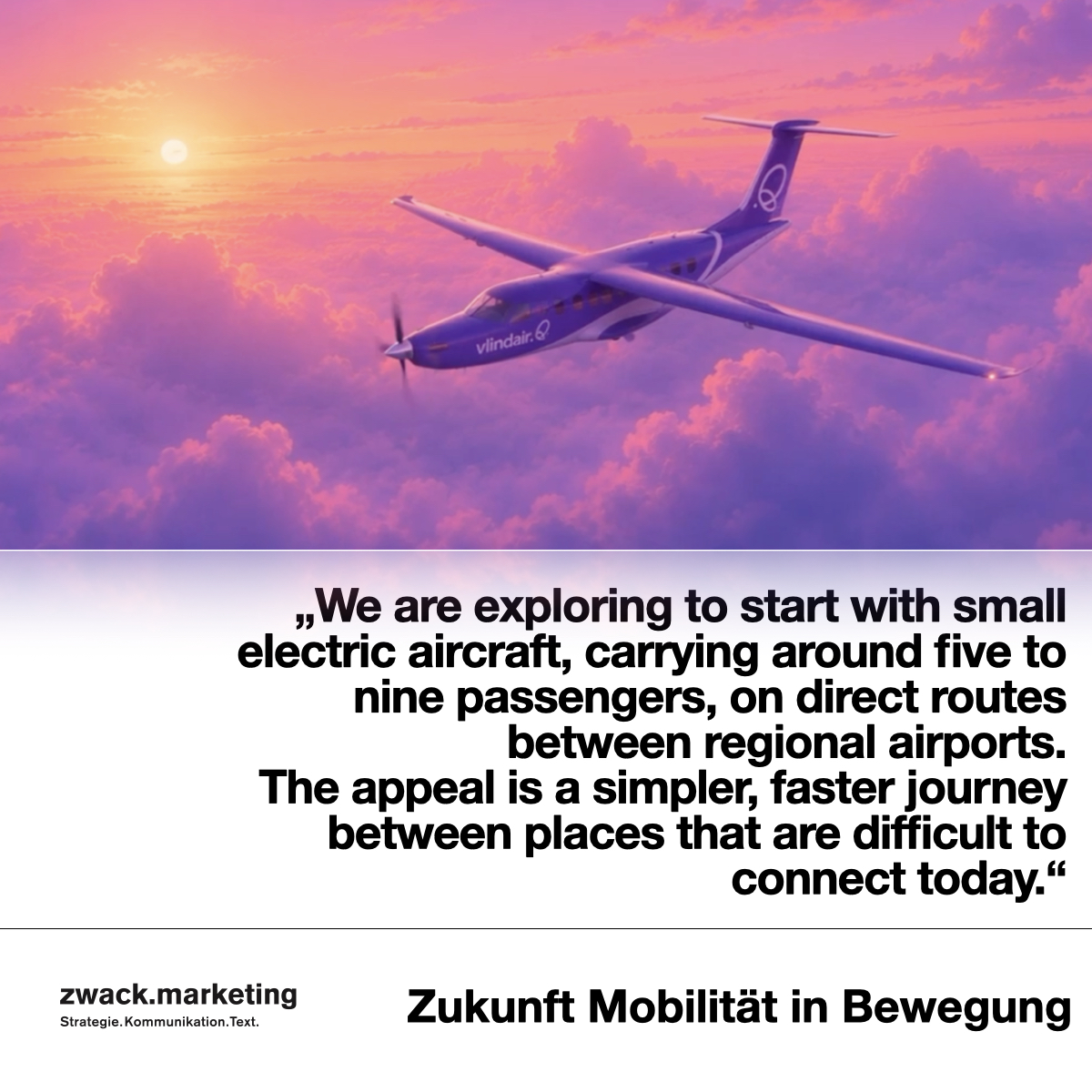
Yona Hümmels: We exploring to start with small electric aircraft, carrying around five to nine passengers, on direct routes between regional airports. The appeal is a simpler, faster journey between places that are difficult to connect today. As the technology develops, larger aircraft will allow us to serve more passengers per flight.
It is too early to promise a ticket price. Our network intelligence platform lets us test different aircraft, lease costs, load factors, electricity prices and fares against potential routes. Based on our current modelling, we see a possible case for competing with existing business air travel and, on some journeys, business-class rail. Those calculations still need to be tested against certified aircraft performance and real market demand.
Usable range is one of the biggest constraints. For the routes we are examining, we need at least 350 kilometres of practical route capability, plus enough performance margin to operate safely and reliably in varying conditions. That is a demanding target with today’s battery technology, and it is exactly where the industry is heading. Electric aviation will move beyond a niche when aircraft can meet that operational need, airports can support regular service, and operators can offer journeys that people choose for their time and price advantages as well as their lower environmental impact.
Benjamin Zwack: Thank you, Yona!